
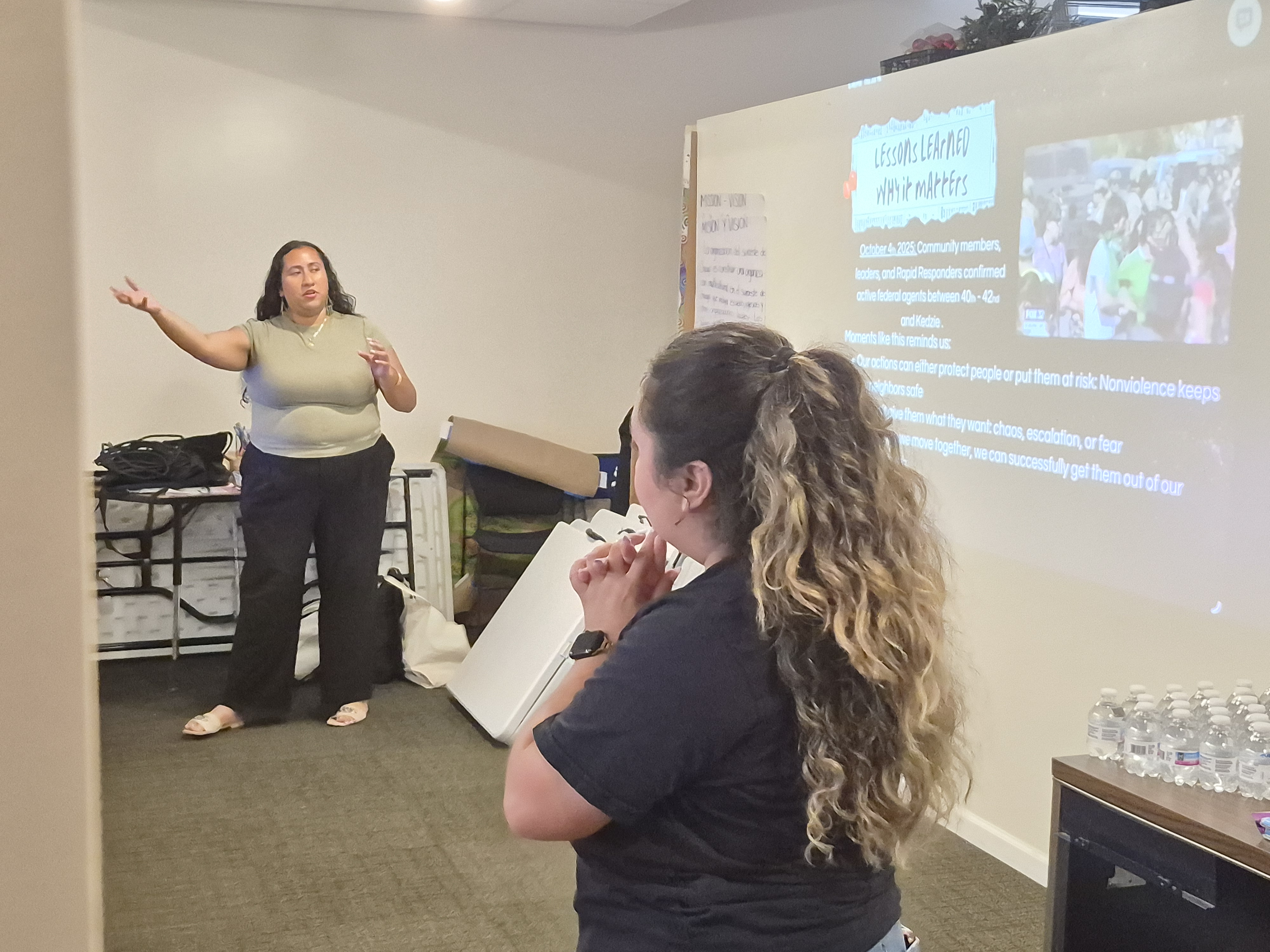
On July 16th, 2026, the Southwest Organizing Project (SWOP), alongside partnerIncrease the Peace (ITP), hosted a Rapid Response Training to equip community members with the knowledge and skills needed to respond safely and effectively during a time of heightened immigration enforcement activity. As concerns continue to grow over the increased presence of U.S. Immigration and Customs Enforcement (ICE) in the community, the training created a space where residents, families, and allies came together to learn how to protect one another while organizing in ways that prioritize safety, dignity, and collective power.
The session was designed for individuals who have been directly impacted by immigration enforcement, as well as those who want to support their neighbors during moments of crisis. Rather than responding out of fear, participants were encouraged to think strategically about how communities can organize together, build strong networks of support, and ensure that power remains in the hands of the people.
Grounded in Dr. Martin Luther King Jr.'s Principles of Nonviolence, the training explored how disciplined, peaceful action can be one of the most powerful tools for creating change while protecting community members. Organizers emphasized that nonviolence is not passive—it is a deliberate strategy that requires preparation, courage, and an understanding of how to respond under pressure.
Community Organizers from Increase the Peace led the presentation, drawing from their own firsthand experiences during demonstrations and public actions. They shared stories of moments when situations escalated rapidly, including instances where they were tear-gassed while working to keep community members safe during protests. These personal experiences highlighted just how quickly circumstances can change and reinforced the importance of remaining calm, prepared, and focused during high-stress situations.
Throughout the training, participants learned about their rights when interacting with law enforcement and immigration officials, as well as the importance of documenting incidents safely, communicating clearly with fellow responders, and avoiding actions that could unintentionally escalate tense situations. Organizers also discussed how public perception and media narratives can influence how individuals and movements are viewed, stressing the importance of maintaining discipline, practicing nonviolence, and being mindful of how actions are interpreted during moments of conflict.
When asked about why this training was important at a time like this, one of the SWOP’s Organizers shared this. “I think this is important because there’s a lot going on in the community right now and we have Know Your Rights’ trainings all the time, but we never talk about how important the non-violence part is. I attended one of these training and it made be think ‘YES, this is EXACTLY what we need’. We are working with a lot of young people, but this affects people of all ages throughout the community when those from outside of it are taking our friends and family. In those times, tension is at its highest and we need to be able to decide how we move within that tension.”
The discussion encouraged participants to think beyond individual responses and instead focus on building a culture of collective care and accountability. By preparing community members before emergencies arise, SWOP and Increase the Peace hope to strengthen neighborhood networks that can respond quickly, support affected families and protect the well-being of everyone involved.
As the training concluded, attendees left with practical knowledge, a deeper understanding of their rights, and a renewed sense of solidarity. In uncertain times, SWOP and Increase the Peace reaffirmed that informed, organized, and connected communities are better equipped to respond to challenges while standing together in defense of one another with courage, compassion, and nonviolence.


